Cairo - Ancient Power in a Modern Megacity
Cairo - in Egypt - does not soften itself for newcomers. Between airport entropy, midnight traffic and the smog-veiled Nile, the city resists romanticization. And yet, just beyond its highways, the Pyramids of Giza rise with geometric certainty — reminders that political power may dissolve, while the architecture it commissions continues to define imagination centuries later.
At 11:30 pm Cairo doesn’t soften itself for newcomers. The arrival inside the airport feels suspended in another decade. The flow of passengers is dense and undirected; groups gather on the floor in apparent wait, lines form and dissolve without clear explanation. The entry visa sticker can be purchased from your guide through the airport for 25$ cash - surprisingly, he is also the one who officially sticks it in your passport. There are multiple checks - of bags, of documents, of things unclear - and then an hour-long wait for luggage in a hall where suitcases pile onto one another, fall from the belt, jam the mechanism, and must be manually untangled by a staff member that climbs onto the conveyor. The density of the bodies presses in from every direction, everyone attempting to rush to reach the exit.
And once you finally get into the car - in a brief sigh of relief - you are tossed in the city’s night chaos. Even at that hour the traffic thickens into a slow-moving organism of cars, motorbikes, buses, bicycles, pedestrians. Drivers invent their own lanes, occupying whatever space they need rather than following any rule. Headlights blur in a cloud of dust and exhaust. Anarchy seems to rule: shops remain open at their discretion and illuminate the streets with their fluorescent lights - glittering dresses, brass lamps, crates of fruit, chicken roasted on improvised grills along the side of the road. The city engulfs you, not caring to curate its first impression.
The dense, acrid smell of gasoline hangs low over everything. When you finally reach your hotel and look out toward the Nile, the smog leaves an opaque veil over the glittering lights on the water. Even the early morning light cannot dissolve the cloud that permeates everything it touches.
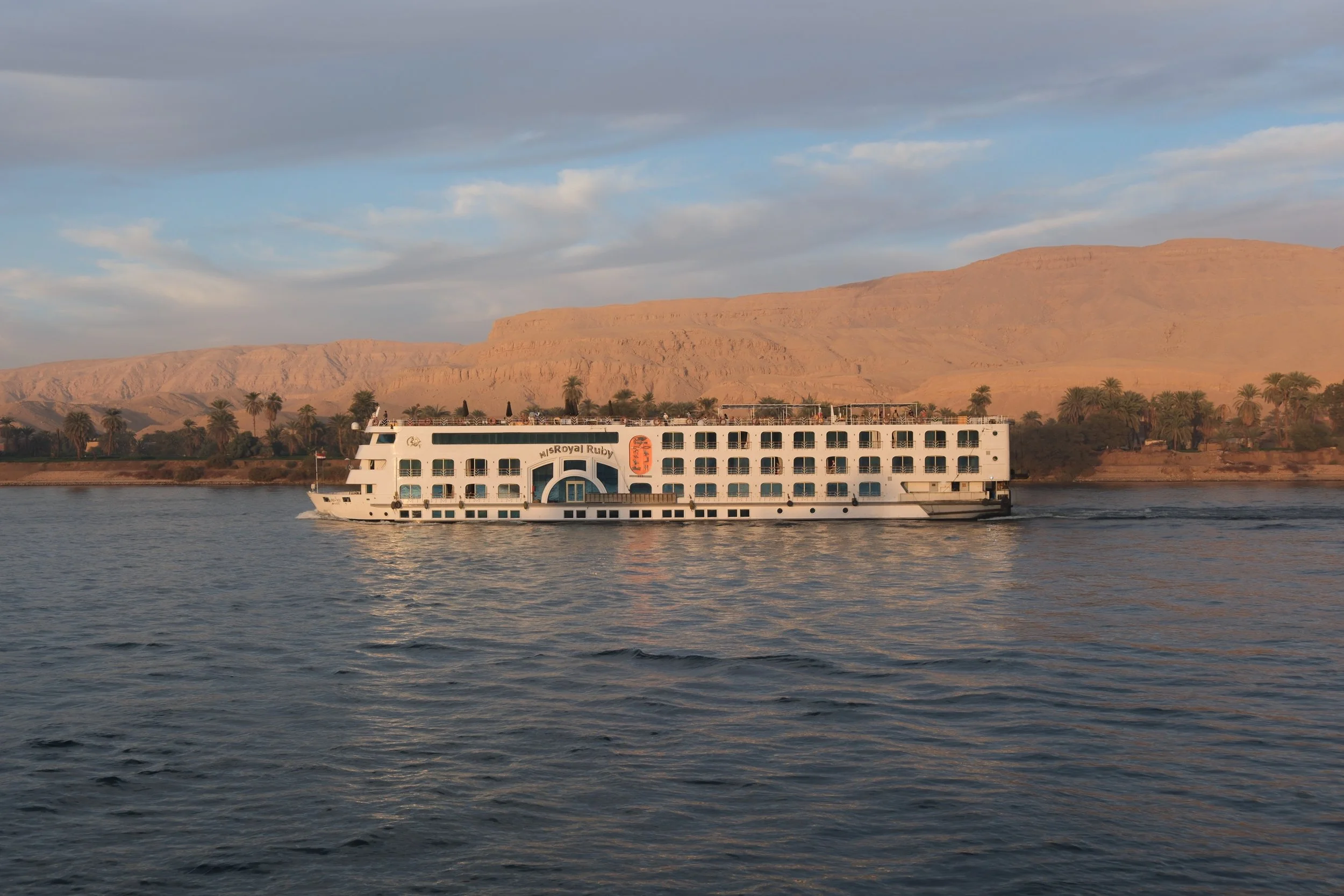
Cairo unsettles. It is not a museum city built around its past. It is intensely alive, overpopulated and absorbed in its present. Only later, after traveling south to Luxor and along the Nile, will Cairo begin to make more sense.
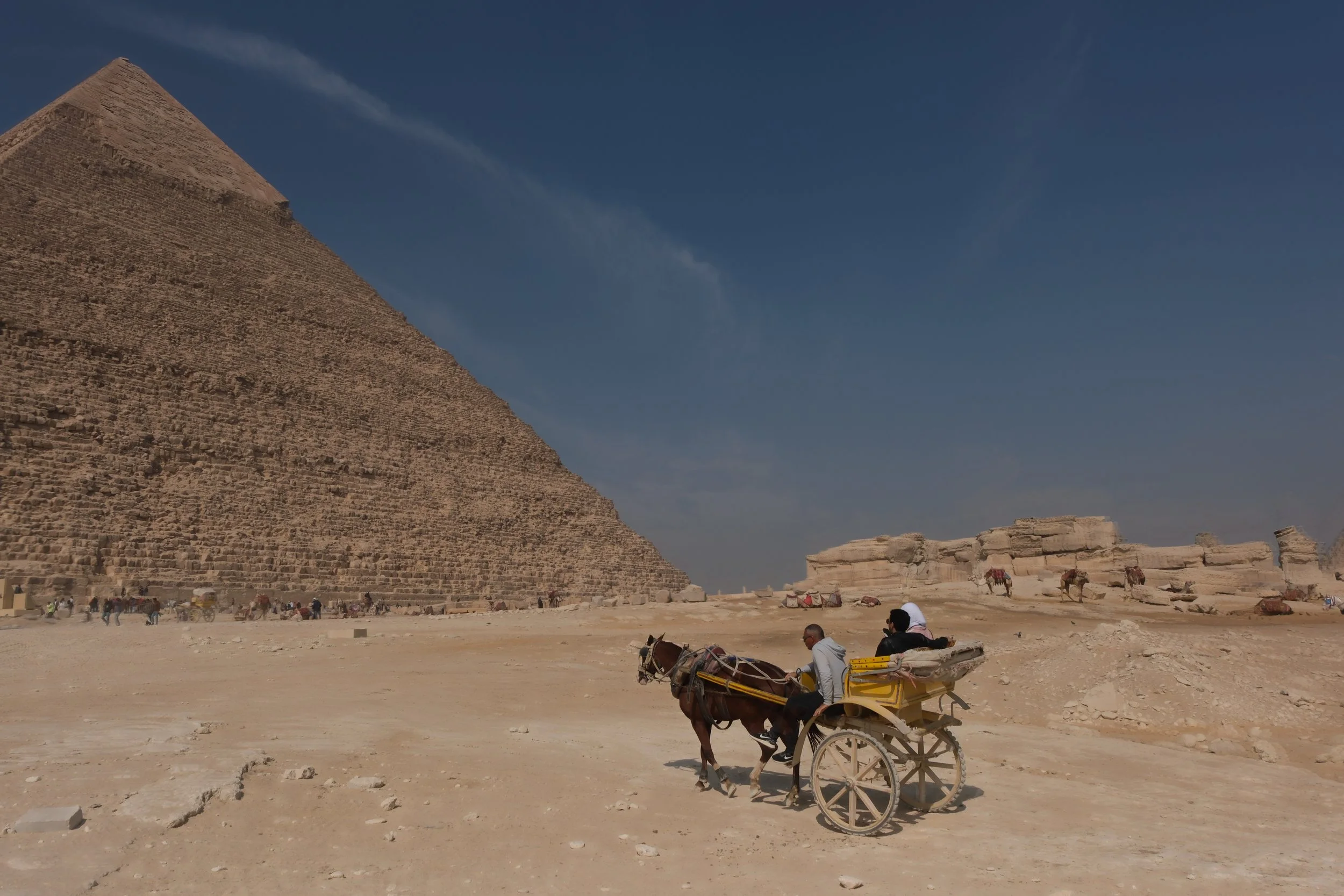
West of the river lies the plateau of Giza - the land of the dead. Here, political power once rose toward the sky rather than being concealed underground. The pyramids predate the hidden tombs of the Valley of the Kings; they belong to an era in which pharaonic authority was declared through geometry and scale. They stand at the threshold of the Sahara, emerging from sand and haze with a proportion that feels almost inhuman. Their surfaces are eroded, their limestone casing long stripped away, yet their forms remain uncompromised. The seem less constructed than inevitable, as if they’d been there even before man-kind.
The modern city presses close behind them - affordable apartment blocks, winding highways where the Nile once flowed. The contrast isn’t subtle: the pyramids coexist with the diesel fumes and urban sprawl.
The Sphinx, its nose long gone, watches over the plateau with its strange composure, less monumental than familiar. It appears at once to guard but also welcome visitors.
What is striking of the pyramids is not only their scale, but their purpose. In Giza, power had to be elevated. The tomb became architecture; as afterlife was monumentalized so that the souls of pharaohs might ascend towards the gods. That choice, however, made the structures vulnerable to thiefs - such a visibile target ensured that the burial chambers were emptied centuries ago. The gold, the furniture, the ceremonial objects disappeared, leaving behind only the stone.
To understand the weight of the afterlife in ancient Egypt beyond what can be read in books, one can step inside the Grand Egyptian Museum (GEM). Opened in November 2025, the museum stands in deliberate dialogue with the pyramids. Its architecture is angular and luminous, modern yet referencing the geometry of the plateau. Inside, the atmosphere shifts dramatically. Visitors are led in a clear, ordered path through centuries of ancient history. The building is spacious, intuitive, meticulously organized; it allows you to move calmly through the galleries even when the museum is crowded.
Here artifacts reclaim the narrative that the pyramids or tombs alone cannot tell. The full collection of Tutankhamen - preserved thanks to how hidden his tomb was in the Valley of the Kings - was untouched by thieves. Today it reveals the extraordinary richness that once accompanied the death of a royal. Gilded marks, jewelers, beds and furniture, chariots, toys, the matryoshka sequence of sarcophagi: a complete universe of objects meant to sustain eternity. Tutankhamen was a short lived and relatively minor pharaoh, and yet his funerary assemblage was so grand. One can only imagine what was lost in the tombs of the greater rulers such as Ramses II.
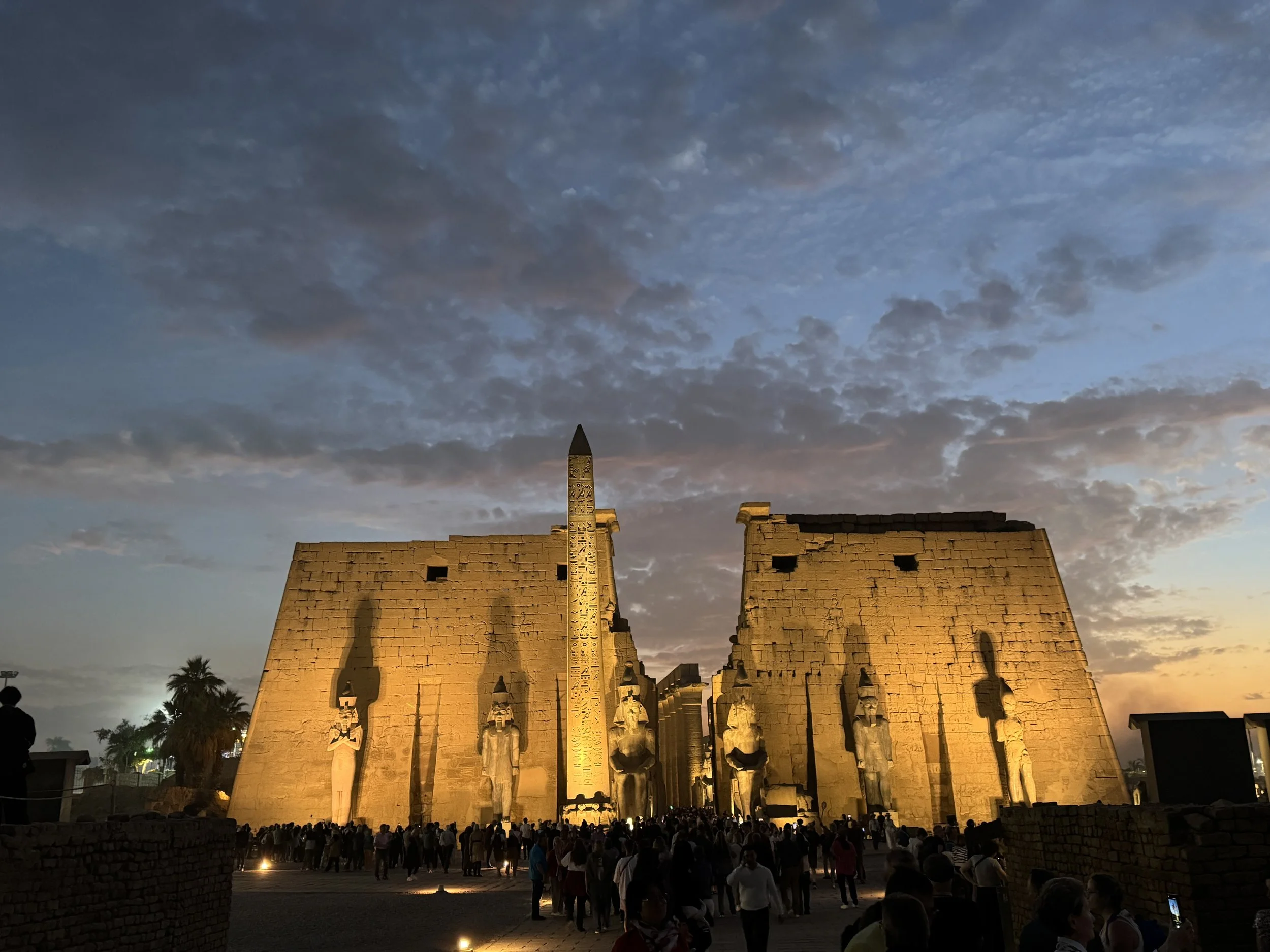
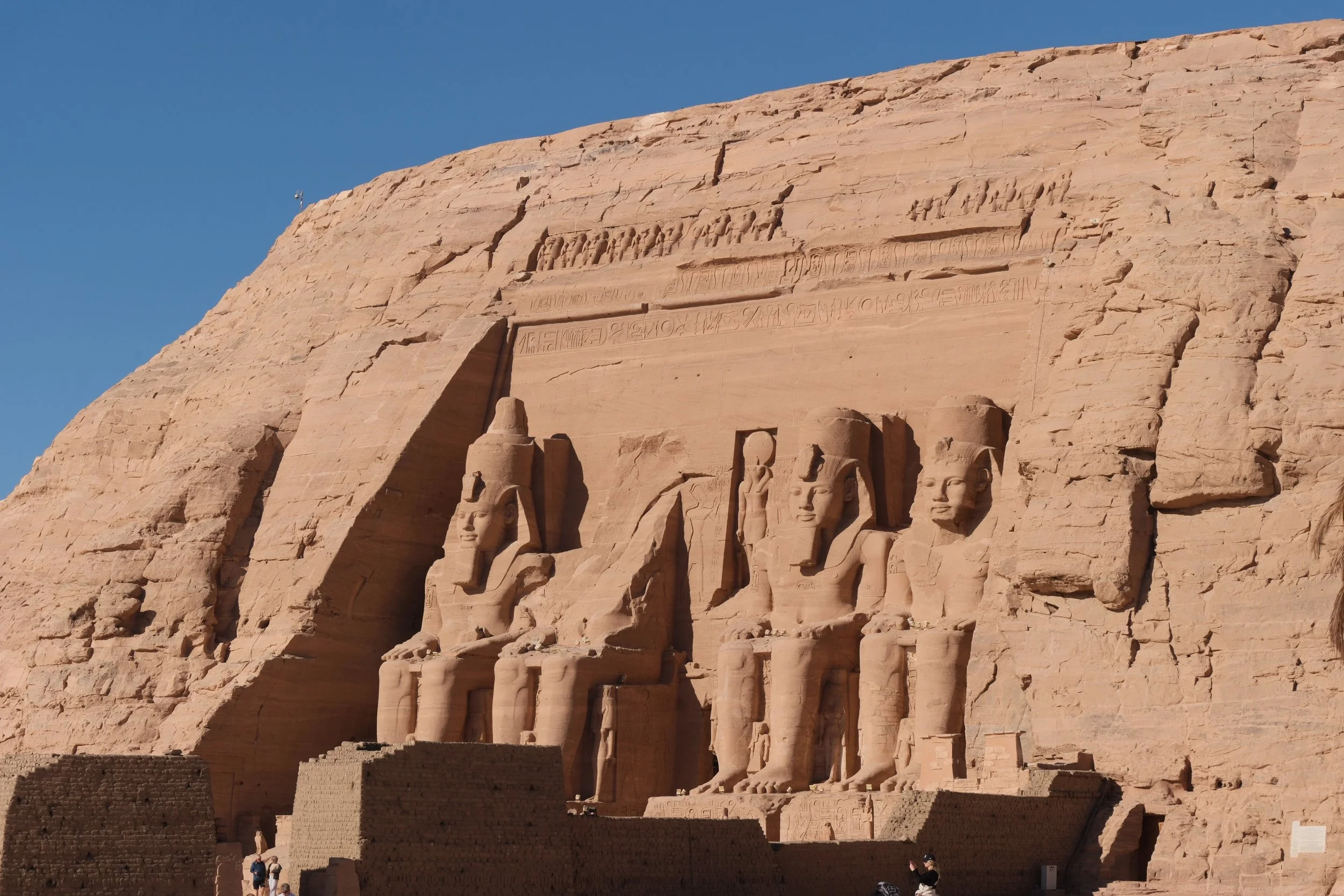
In ancient Egypt, the afterlife mattered more than public life. Power invested not in temporary display but in permanence - in ensuring that authority extended into eternity. Dynasties ended, regimes fell, names of rulers dissolved into obscurity, but the aesthetic language they commissioned - the reliefs, the hieroglyphs, the monumental forms built, stories left for us to discover - continue to shape our image of power itself.
Returning to the east side of the Nile, is the opportunity to get to know yet another layer of the city of Cairo: the present.
Khan el-Khalili is a sudden immersion into it. Streets greyed by exhaust, motorbikes and cars threading through crowds, merchants negotiating prices with their theatrical insistence. It is loud and overwhelming. A functional chaos where everyone appears to be pursuing an urgent transaction.
A short walk away, the Mosque of Al-Azhar offers a different rhythm. At the entrance, women are handed long skirts and head coverings - skillfully matched with your outfit by the attendant - it is a subtle transition across a threshold like removing one’s shoes. Inside, the space is not pristine or curated, it is lived in, social.
People arrive steadily, waiting for the call to prayer. The salat marks five key moments of the day: dawn, noon, afternoon, sunset, and night. It follows a precise sequence - preceded by the purification, then standing, bowing, prostrating, sitting. The ritual engages the whole body and is communal. Strangers align shoulder to shoulder, oriented toward the Mecca. It is a collective spirituality rather than an individual meditation - disciplined and synchronized.
Cairo is a city of stratifications. Remote past, recent past, and living present coexist without an attempt to harmonize, each fighting to keep its space. The ancient monuments do not dominate the city; they persist within it. The contemporary metropolis doesn’t erase the past, it simply continues building around it.
Egypt can’t be reconciled into a single imagery of glory or decay. It must be crossed, accepting that not everything aligns, that the forms of depth and culture built by its ancient civilization do not repeat themselves in the present. Here we understand how political power that defined our civilization may dissolve, but the cultural forms it produces often outlive it, shaping imagination thousands of years later, indifferent to the regimes that first imagined them.