Lisbon Weekend - Day 1

I arrived in Lisbon with little expectation — an advantage when discovering a city as layered as this one. Lisbon isn’t a city that announces itself loudly; it unfolds piece by piece, with every uphill drift and every stone step underfoot. With only a weekend ahead, the goal wasn’t to rush through landmarks, but to notice what emerges when you move slowly: how history, daily life, and small rituals coexist in a place that feels permanently suspended between past and present.
Located on the western edge of the country and facing the Atlantic Ocean, Lisbon is Europe’s westernmost capital. The city is enclosed within a natural bay formed by the Tagus River estuary, now scenically crossed by the Vasco da Gama and the 25 de Abril bridges. Its position at what was once considered the edge of the known world made it feel remote compared to the more central capitals of Western Europe. At the same time, its harbor made it an ideal settlement: from a commercial hub for Phoenician traders to an outpost for Portugal’s maritime expansion in the 15th century.
This offbeat city’s peculiarity lies in its layered history combined with a persistent sense of saudade. As Italian writer Antonio Tabucchi — who studied Portugal at length — explained, saudade is a form of melancholy tied to what was, tempered by hope for what may still come. It’s a subtle, complex emotion, and one that seems embedded in Lisbon’s urban fabric. Much of the city appears resistant to the aggressive modernization that reshaped other European capitals, and its port-city traditions remain palpable. Facades are softened by vibrant azulejo tiles, sorrowful fado melodies drift from restaurants, and walking up and down Lisbon’s steep streets, it’s easy to feel momentarily displaced in time.
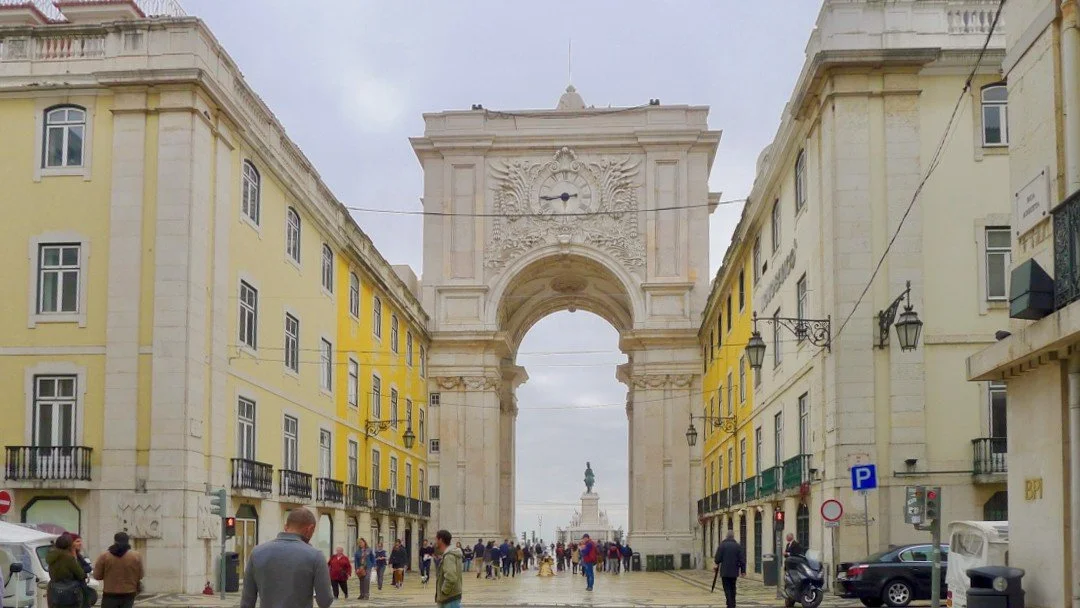
Rua Augusta Arch
Lisbon’s metro connects directly from the airport to the city center and remains one of the simplest ways to arrive. In roughly twenty-five minutes, you move from transit to everyday life. Public transport generally runs until around 1 a.m.; later in the evening, taxis or ride-hailing apps are the most practical option.
For moving around, the Viva Viagem card still offers the most flexibility, working across metro, buses, trams, and funiculars. Lisbon is walkable, but rarely flat — progress will be slow and occasionally vertical, and that’s part of the experience.

Rossio Square (Pedro IV Square)
Avenida da Liberdade is a good starting point: a broad, orderly boulevard whose symmetry feels deliberate. Built as part of Lisbon’s 19th-century expansion, it reflects a moment when the city looked toward other European capitals for inspiration — open space, controlled proportions, a sense of calm grandeur.
That sense of order fades quickly downhill. Streets narrow, surfaces become uneven, and the city’s texture takes over. Rossio Square marks this transition clearly. Long a focal point of public life, it has witnessed everything from royal celebrations to political unrest. Today, it functions less as a monument than as a crossroads — a place people continuously pass through, layering presence over time. Look down as well as up: the black-and-white mosaic pavement recreates the illusion of rippling waves.
This is also the right place for a quick sip of ginjinha — or ginja — the traditional Portuguese sour cherry liqueur, often served in small chocolate cups. The most famous bar bearing its name is located on the right side of Lisbon’s National Theatre. To recognize the best ginjinha, check that it was made using cherries from Óbidos and Alcobaça. It’s deceptively refreshing, so drink responsibly.
From here, a small detour through the streets on the right leads to Rua de Santa Justa and the Santa Justa Lift. Built in the early 1900s to connect different levels of the city, it is now one of Lisbon’s most recognizable landmarks. The structure is worth seeing, even if the long queues make riding it less appealing on a tight schedule.
Rua Augusta pulls you naturally toward the monumental arch at the end of the street: an imposing gateway into Praça do Comércio, the grandest square in Lisbon.

Detail of Rua Augusta Arch
The square opens directly onto the Tagus River and is still referred to as Terreiro do Paço, or Palace Yard, as the Royal Ribeira Palace once stood here before being destroyed in the 1755 earthquake. When rebuilt, its vast openness was conceived as a safety measure, allowing people to gather in the event of future seismic activity. At its center stands a bronze equestrian statue of King José I, inaugurated in 1775.
Praça do Comércio has also been the stage for pivotal moments in Portuguese history. In 1908, it witnessed the assassination of King Carlos I and his eldest son, Luís Filipe. His second son, Manuel II, would reign for only two years before the monarchy was abolished in 1910.

Praça do Comércio
Opposite the arch, along the riverbank, lies Cais das Colunas — the ceremonial gateway for guests arriving by sea. This marble staircase, guarded by two white columns, descends directly into the water. Depending on the tide, the steps may be partially submerged or fully accessible, inviting you closer to the river.

Cais das Colunas, in Praça do Comércio
Now comes the hike. Lisbon is best explored on foot, but comfortable sneakers are essential: steep streets connect Baixa to Chiado and Bairro Alto, and the climb is unavoidable.
Chiado is one of Lisbon’s main shopping districts. Between Rua do Carmo, Rua Garrett, and Rua da Misericórdia, you’ll find a mix of high-street brands and distinctive local shops: leather gloves at Luvaria Ulisses, vintage clothing at A Outra Face da Lua, and one of the smallest bookstores in the world, Livraria do Simão.
Follow Rua do Carmo until Largo do Carmo, where an unexpected sight appears: the Convento da Ordem do Carmo. Built at the end of the 14th century to host more than seventy clergy members, the convent was severely damaged during the 1755 earthquake. Although partial repairs were made over the years, it was never fully reconstructed. The building served various roles — housing the Royal Guard, infantry, and cavalry — before eventually becoming an archaeological museum.
Walking into this roofless church is a disorienting experience. Exposed to the sky, the structure carries a surreal atmosphere, making the force of the earthquake that laid it bare almost tangible.

Convento da Ordem do Carmo
From here, Praça Luís de Camões leads you onward — dedicated to the poet of Portugal’s epic Os Lusíadas. Continue down Rua do Alecrim toward the river, crossing the notorious Pink Street (Rua Nova do Carvalho), in the Cais do Sodré neighborhood. Quiet during the day and packed at night, it was once Lisbon’s red-light district, frequented by sailors arriving at the port. Since being painted in 2013, the street’s infamous past has gradually given way to a livelier, more progressive spirit.

Tarte de amêndoa (almond tart) and the Bolo de Arroz (rice cake) at Confeitaria Nacional in Praça da Figueira
One of Lisbon’s pleasures is how naturally food integrates into everyday life. Eating well doesn’t require planning or ceremony; it’s part of the city’s rhythm. Confeitaria Nacional, in Praça da Figueira, is a long-established café where formality and familiarity coexist. The experience isn’t about novelty, but repetition — years and years of practice behind marvellous confections. Try the tarte de amêndoa (almond tart) and the bolo de arroz (rice cake).
In Lisbon, you’ll also find remarkable coffee — and for an Italian to admit it, it means it’s extremely good. Beware: many bars don’t have a menu, so you’ll simply need to know your order. Ask for um café for a short espresso, um pingo if you like a drop of milk, or um abatanado if you’re aiming for something closer to an Americano.
As you eat your way through the city center, make a stop at Casa Portuguesa do Pastel de Bacalhau, home of the fried codfish cake filled with creamy Serra da Estrela cheese.

Casa Portuguesa do Pastel de Bacalhau
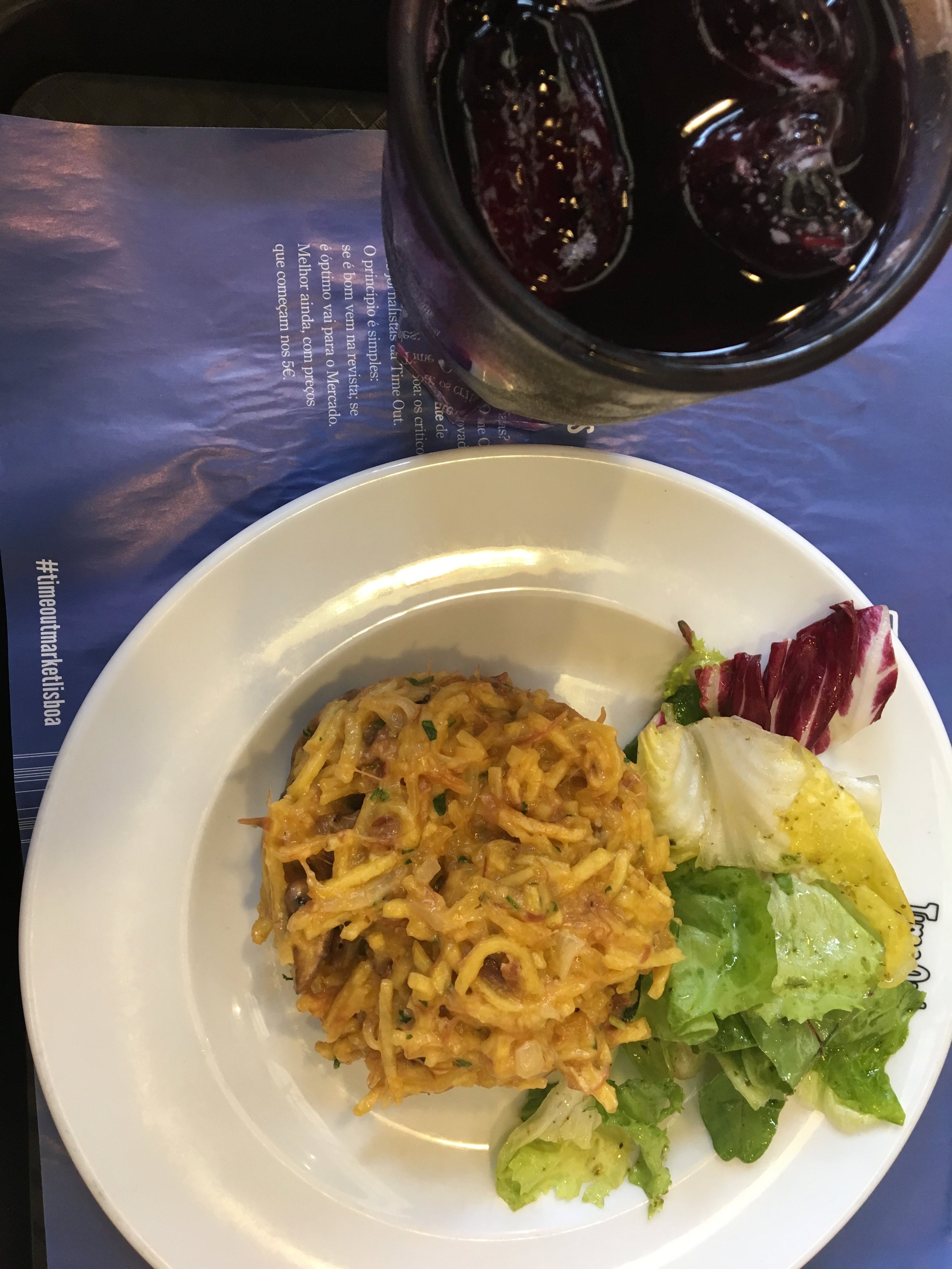
Bacalhau a Bras
While Lisbon offers countless outstanding places to eat, the Time Out Market — housed in the former Mercado da Ribeira — remains a reliable stop. Once the city’s traditional food market, it was transformed in 2014 into a food hall bringing together chefs and restaurants under one roof. More crowded and international than in its early years, it still offers a snapshot of Lisbon’s contemporary food scene. At the shared tables, you can taste bacalhau à Brás by Chef Miguel Castro e Silva or a classic steak from Café de São Bento.
A very well-known touristic stop — and one that is absolutely not overrated — is the Pastéis de Belém bakery near the Jerónimos Monastery. Here, they prepare the original Portuguese egg tarts following a closely guarded recipe. I must have overdosed on sugar after eating more than I care to admit, unable to get over the crunch of the flaky pastry and the richness of the egg-based cream. Dust them with cinnamon for an extra layer of warmth.
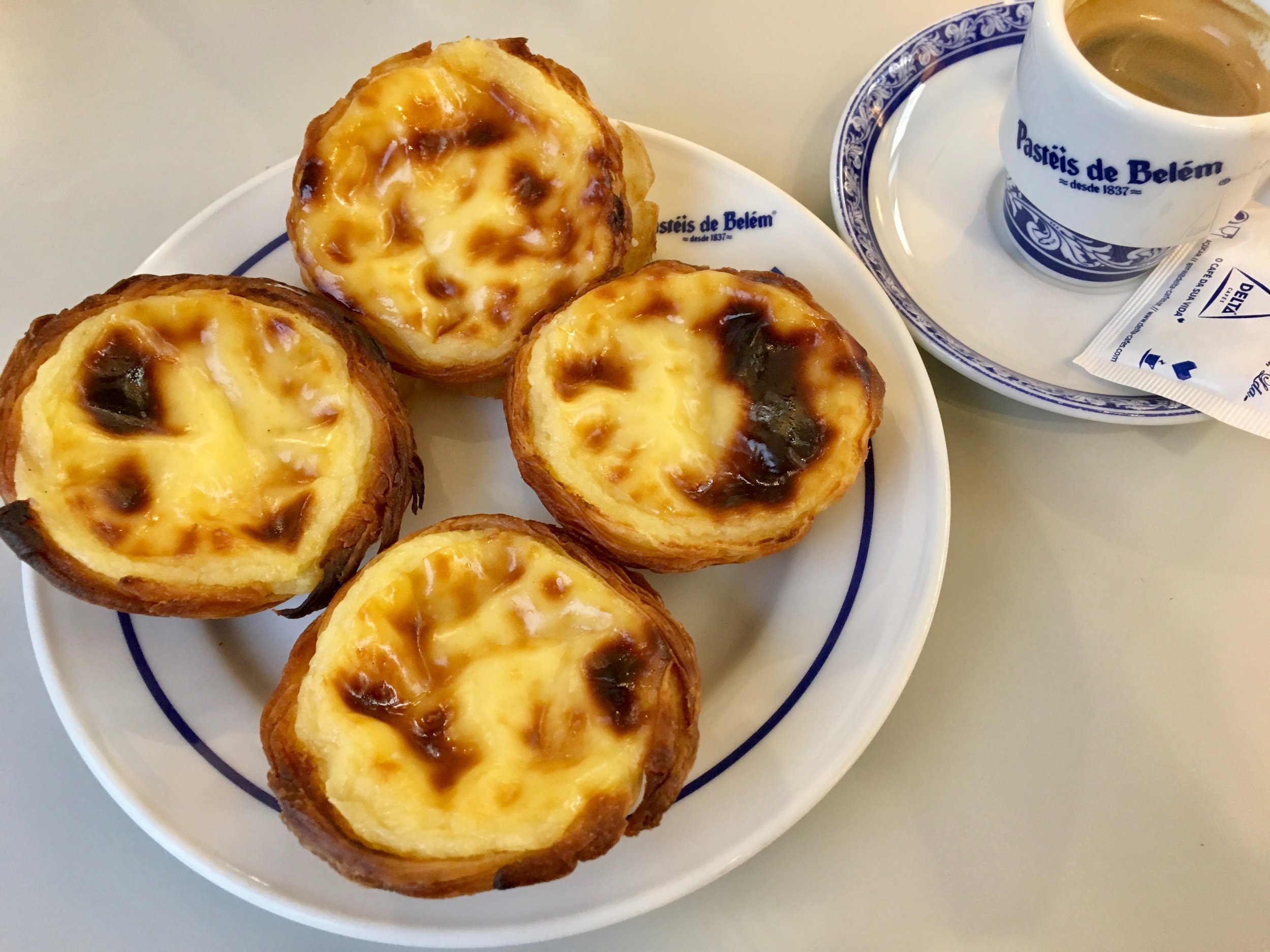
Pasteis de Belem
Head to Cais do Sodré station to catch a direct train to Belém, which takes around ten minutes (alternatively, you can walk there in about an hour along the river).
The first stop in Belém is the place the district itself owes its name to. The parish of Belém was once an autonomous municipality named after Santa Maria de Belém. While the iconic tower is a must-see, the real reason to come here is the Jerónimos Monastery. Commissioned by King Manuel I, O Venturoso (“the Adventurous”), it was built to celebrate Vasco da Gama’s return after discovering the sea route to India. Here, Gothic architecture meets intricate Renaissance motifs, drawing visitors from the exterior into an equally impressive interior.
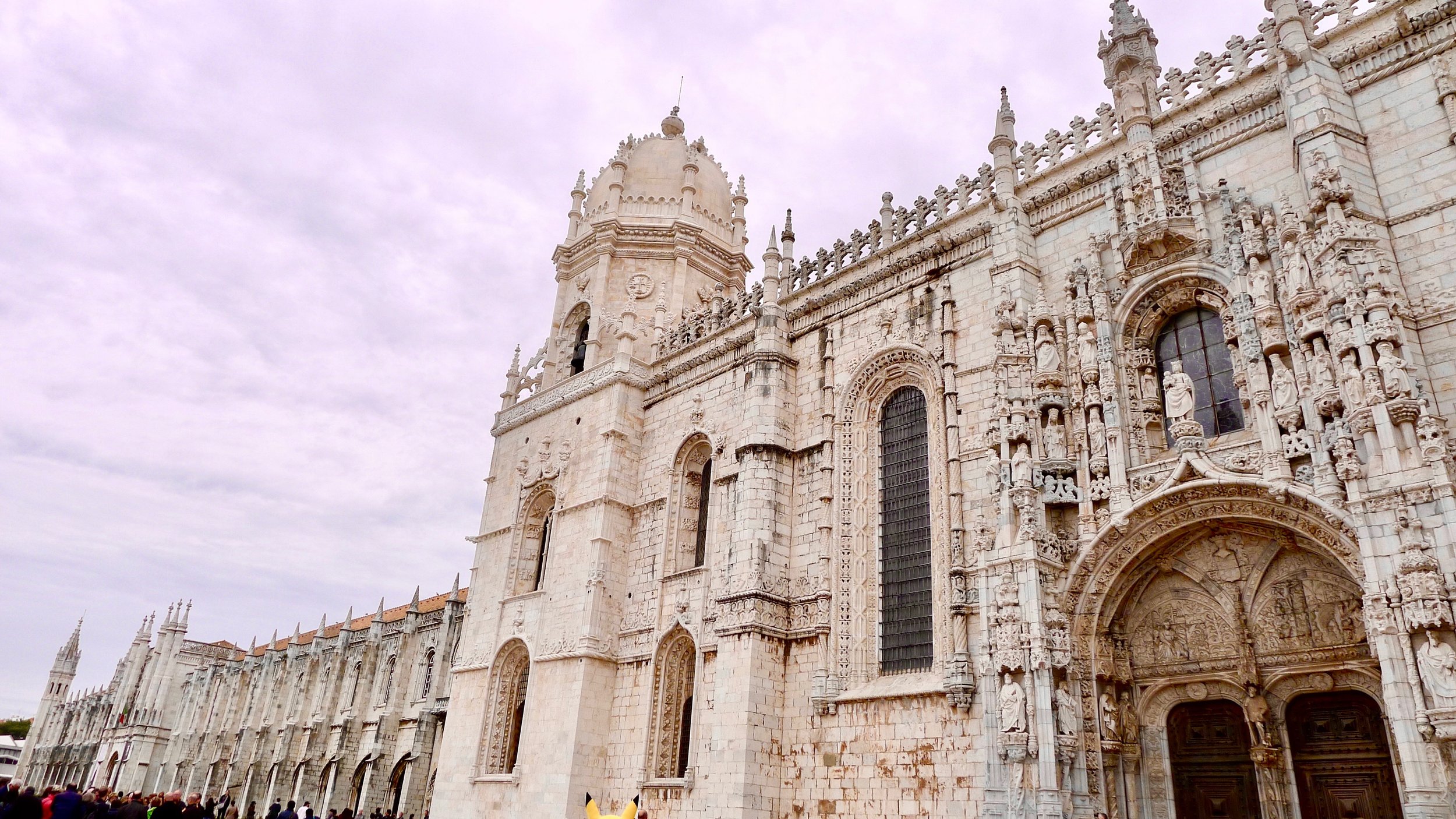
The south portal of the Jeronimos Monastery
As you walk along the monastery, take time to observe the elaborate ornaments framing the South Portal, far larger and more majestic than the Axial Portal leading to the main altar. The decorations on the pinnacles and gables showcase the richness of Manueline ornamentation.

The cloister
Entering the church, you are greeted by the tombs of Vasco da Gama and Luís de Camões, who have rested here since the late 19th century. The solemnity of the space is softened by the vivid colors of the stained-glass windows, allowing daylight to filter down from above.
The church opens onto the cloisters, where two floors of finely carved limestone surround a central courtyard. Slender columns and ornate mullions — delicate as finely knitted lace — narrate stories of sailors and their journeys at sea. The richness of the decoration was meant to reflect Portugal’s growing power during the Age of Discoveries. Beyond the cloisters, there is much more to explore, from the refectory adorned with azulejos to the adjacent Archaeology and Maritime museums.
To complete the day, make your way to the Torre de Belém, also known as the Torre de São Vicente. Built as a defensive structure after King John II deemed existing fortifications insufficient, the tower overlooks the Tagus River at its mouth. It also served as a ceremonial gateway for navigators leaving and returning to Lisbon. Both the monastery and the tower have been designated UNESCO World Heritage Sites.
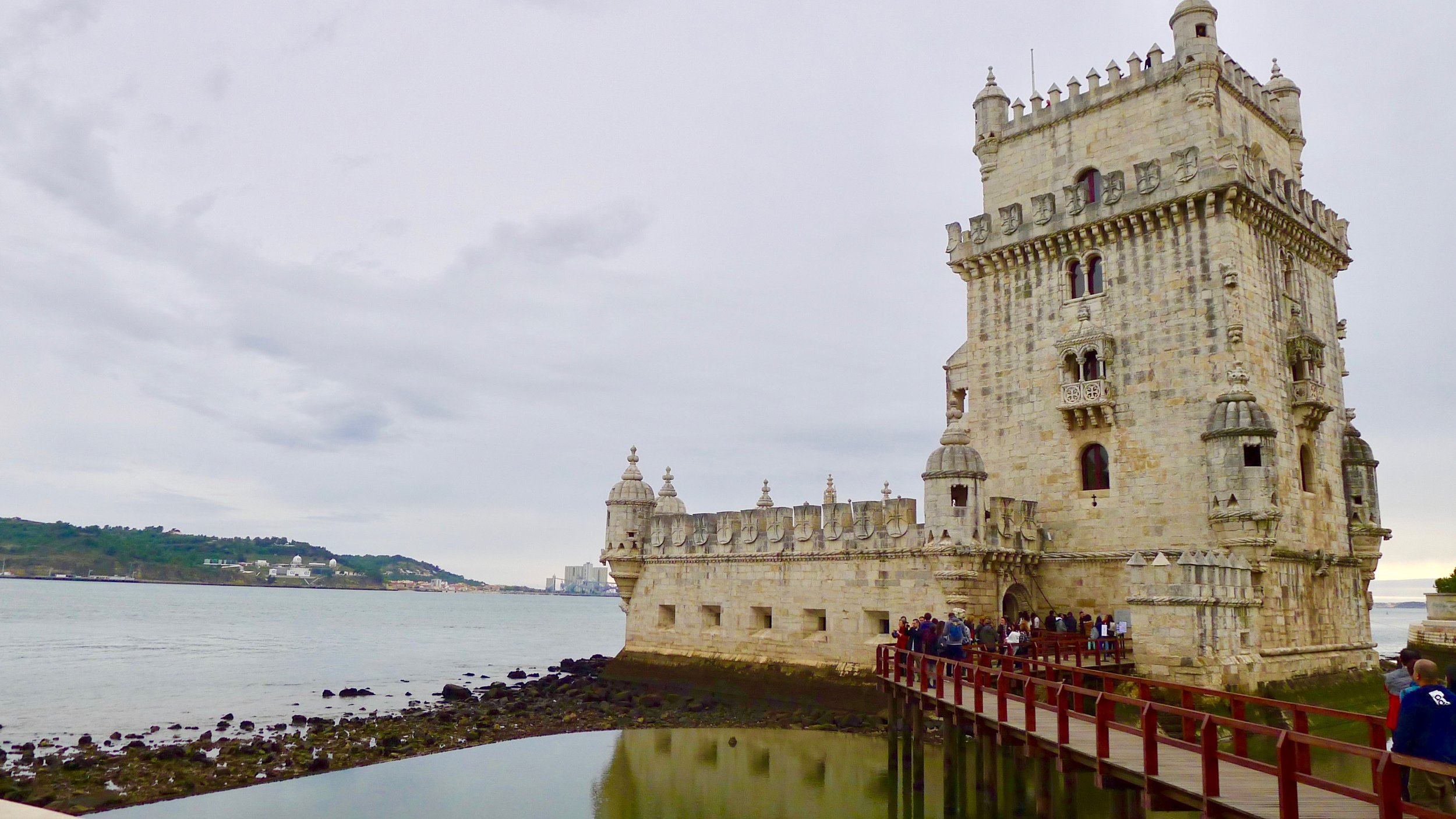
Torre de Belem orTorre de São Vicente
From here, you can return to Lisbon’s historic center by walking along the Tagus, following the river as the sun begins to set — a fitting close to a day shaped by movement, memory, and water.

If you still have energy, Lisbon offers plenty of ways to stretch the evening. Park Lisbon is a rooftop bar hidden above a parking structure, and the wide views over the city and the river make it an ideal spot for a first drink.
From there, the night naturally continues in Bairro Alto or back along Pink Street (Rua Nova do Carvalho), where bars spill into the street and you can get lost in the music and atmosphere — a reminder that Lisbon holds both introspection and exuberance in equal measure.
This article was first written in November 2016 - re-edited in January 2026.