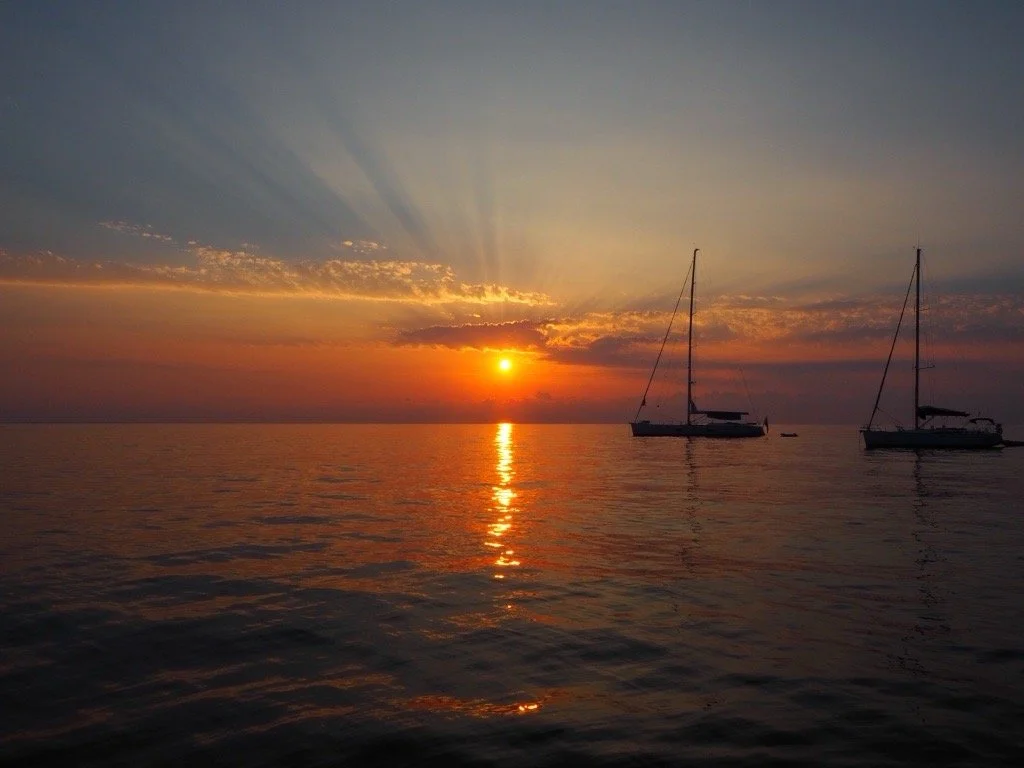
As you sail north across the Bonifacio Strait, there is a moment when Sardinia is still visible behind you and Corsica appears on the horizon, a hazy grey suggestion of land up ahead. The wind picks up the way it always does in this channel, an ever-so-present protagonist, funneled between two coastlines that have spent several thousand years arguing over who it belongs to. You are crossing an invisible line, floating between Italian water on one side and French on the other.
I have spent many summers crossing gaps like that one, stretches of water with stunningly beautiful coastlines, so unique I didn't notice what they had in common. A week in the Cyclades, white rock and the relentless strength of the Meltemi wind. Another in the Ionian, greener, softer, rocky and still full of animals. From Sardinia into Corsica, bright cyan water along the dramatic western edge of the Tyrrhenian. The Aeolians, defined by sulphurous and obsidian rocks, and a volcano that is still very much active. Favignana and the Egadi islands, with their barren, rocky, and arid calcarenite coastlines. The Neapolitan Archipelago, with Vesuvius as a backdrop for the cliffs of Capri, the pastel harbor of Procida, and the green slopes of Ischia. And then the Dalmatian coast of Croatia, karst limestone and dense forests that run to the end of cliffs. Each trip filed itself away as its own story, its own weather, and every year showed me the world from a different angle, always from the water.
With all its blinding beauty, the Mediterranean is often sold to tourists as a backdrop, somewhere blue and photogenic for other things to happen in front of. That has never been what held my attention. What holds it is that this sea is small enough to cross from island to island, and connected enough to fight over, and for several thousand years, that combination did something no single civilization could have done alone. Phoenicians traded alphabets along these coasts before anyone had agreed on what a coast was for. Greeks left a way of thinking, philosophy, theatre, history, geometry and the first experiments in democracy, carried along every coast they colonized, and fought among themselves more than with the people they settled among. Rome turned that inheritance into infrastructure: arches and aqueducts, a legal code that outlived the empire, and a Latin that became the root of modern languages across the Mediterranean and beyond. Arab navigators, Norman kings, Venetian merchants, Ottoman administrators - all of them handled the same handful of islands, and every time the sea changed hands, something got left behind that the new hand didn't erase. A word, a recipe, a piece of art or architecture that still lives on today.
All of the places I will be writing about were shaped by the exchanges that happened within this relatively small stretch of sea. The obsidian traded out of the Aeolians in the Neolithic reached people who never walked the islands. The naval battle fought off the Egadi Islands in 241 BC ended the First Punic War and drove Carthage out of Sicily. Capri, once settled by Greeks, became an emperor’s retreat, with Tiberius spending the last ten years of his life there.
This series will move through some of the routes I have sailed, and to which I hope to add more in the future, across different stretches of this water. It won't just be an itinerary, but a way to explore the Mediterranean, knowing what lies beyond what the eye can see. The birthplace of such rich cultures, made so thanks to the exchange between peoples and traditions that found ways to cross-pollinate. An idea we have partly forgotten in our current day and age, where we're stuck in protecting our turf and forget that what's foreign might help us grow and improve ourselves.
As we make our way back onto that sailboat, moving quickly towards France, the hazy summer afternoon finally reveals the majestic white cliffs of Bonifacio, and a lighthouse stands out, showing the way. All along, just carried on by the wind.